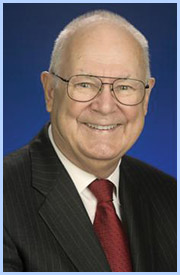
John Husing, Ph.D.

In August 2006, Dr. John Husing was listed by the L.A. Times Magazine as one of the 100 most powerful people shaping life in Southern California. He is a leading authority on the impact of the goods movement industry on the region, and in particular its role as a provider of upward economic mobility to blue collar workers. He has just completed major studies on the impact of the proposed Clean Truck Program at ports of Los Angeles and Long Beach and has recommended some changes in strategy.

In addition, Dr. Husing has spent decades studying the city & county economies of Southern California with a specialty on the Inland Empire. This research began when he began working on his doctoral thesis at Claremont Graduate University in 1964. For the past 43 years, Dr. Husing has conducted extensive research plus interviews with executives and entrepreneurs to understand the forces shaping Southern California. He has a deep understanding of our political process, having managed over 100 partisan and non-partisan campaigns. Today, he uses his extensive knowledge of the region and his political experience to explain the economy to business leaders and policy makers throughout the Southland.

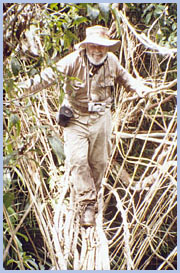
Privately, John Husing enjoys life as an adventurer, taking treks into uncharted territories as well as traveling to 52 different countries. In recent years, he has twice entered the unexplored jungles of NW New Guinea to make first contact with previously undiscovered stone-aged tribes. His last trip was trekking over the Himalayas from Nepal into Tibet. Closer to home, Dr. Husing is an amateur genealogist with his American roots traced back 12 generations to Robert Fuller and his family on the Mayflower.

 
  • For a downloadable version of this introduction to Dr. John Husing in Word® format, click here.

  • To read about Dr. John Husing's first encounter with the Kombai tribe of New Guinea, click here.


For Dr. John Husing's Resume and more information on his research, education, clients, and adventures, click here.


Background: John. E. Husing, Ph.D.

Under John Husing's leadership, Economics & Politics, Inc., the firm owned by he and his wife Debra, has a simple mission statement: "Our goal is to raise the Inland Empire's living standards." Every project the firm undertakes, the vast majority of his writing and all of John Husing's volunteer efforts (such as: Inland Empire Economic Partnership, The Community Foundation, numerous Presentations to City Leadership Training Groups), are devoted to that purpose. In the process, Dr. Husing has come to understand that the various communities and institutions within the inland region play unique roles and they must be harmonized to the extent possible if the region is to prosper. His interest in city, county, transportation, water and school district economic development strategies flows directly from this perspective.

In creating economic development strategies, Dr. Husing takes an holistic approach dealing with the full range of human and physical issues needed to raise living standards in each city and the region. His strategies address job creation through recruitment, retention and expansion of high-end firms (high tech, professional and corporate operations), manufacturing and logistics companies and sales tax generators. He places a heavy emphasis on the interaction between a city's economic development staff and the area's educational institutions and regional organizations. He strongly believes that housing strategies are critical due to their impact on the quality of the labor force that will ultimately reside in a community. Recognizing a need to provide an environment for high-end firms and workers, his recommendations often include efforts to promote such city and regional lifestyle elements such as low crime and an expanded base of cultural arts, high-end restaurants, executive air service and five star hotel development.

A strength of John Husing's work is his belief in personal attention. He performs all of the statistical, analytical, interviewing and strategic work conducted by his company. There are no junior staff members or subcontractors. Having studied the Inland Empire economy for 38 years, he is the authority on the nuances of the forces impacting the region and the roles played by each of its communities. He has pulled together most of the data used to study the region, including providing language to design the legislation that allows cities and counties to access job/payroll information on their resident companies. Having developed these databases, he is acutely aware of the region's location characteristics and how well they do or do not match those of various recruiting targets. For instance, he was the first to spot that the lack of coastal county housing affordability was increasing the flow of high-end workers to cities near to the coastal counties, a fact that has begun to change the region's labor force profile and make appeals to higher paying firms a real possibility.

Dr. Husing's belief that inspiration comes from immersing himself in his projects goes beyond the data. Each year he conducts about 200 "one-on-one" personal interviews with high tech, professional, corporate headquarters, manufacturing, distribution, construction, financial and retail executives in the Inland Empire. The knowledge base derived from this work provides Economics & Politics, Inc. with a unique understanding of the executive view of the strengths, weaknesses, opportunities and threats facing the Inland Empire and its various communities. John Husing believes that an understanding of this real world view of the economy when added to his statistical and analytic work makes it possible to provide policy makers with sound advice on how to raise the region's living standards.

A community college educator at age 23, Dr. Husing has recently seen his career come full circle as he has undertaken two unique economic development projects aimed at assisting Chaffey College and the San Bernardino Community College District in understanding how to better integrate their efforts with the labor force needs of the inland region's business community. In the process, he conducted interviews with every K-12 superintendent in San Bernardino County's urban areas, as well as the superintendents of its regional occupational programs and senior administrators at Cal State San Bernardino and the University of California, Riverside. As workforce training issues are crucial to raising the living standards of the region's blue collar workers as well as providing the framework for expanding its high-end sectors, the information and strategies flowing from this work are allowing Economics & Politics, Inc. to recommend ways that the region's economic development community can help create a new fruitful relationship between local schools and companies.

Economic development strategies are not undertaken in a political vacuum. They only truly work if they have the general acceptance and cooperation of the region's elected officials, company executives, senior governmental staff members and the elected and/or staff leadership of affiliated regional governmental and non-governmental groups as well as the press. Here, John Husing relies upon the experienced he gained in the 1970s and 1980s as a political campaign manager and strategist in an attempt to ensure that the strategies he fosters have a chance to succeed in the real world environment faced by the Inland Empire's very diverse leaders.

While he does not seek controversy, Dr. Husing does not shy from it when he feels very strongly that an issue is having a deleterious impact on the living standards of the Inland Empire's families. For instance, he has been a constant voice for regional cooperation in the belief that the area is so poorly understood that the last thing it needs is internal disagreements. On another front, he has taken strong exception to a statewide community college move to ban acceptance of high school work for skill class college credit in the belief that it discards an important motivational tool for younger students.